
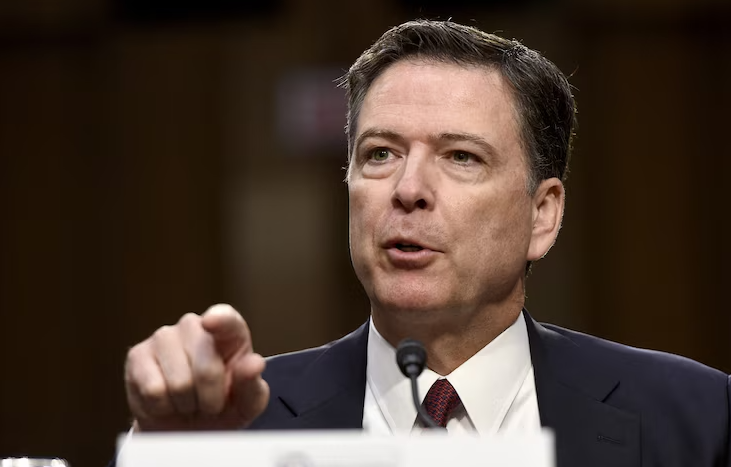
ALEXANDRIA, VA. — A federal magistrate judge has delivered a blistering rebuke of the Justice Department’s prosecution of former FBI Director James Comey, finding “a disturbing pattern of profound investigative missteps” that may have undermined the grand jury that indicted him
In a 24-page opinion released Monday, U.S. Magistrate Judge William Fitzpatrick ordered prosecutors to turn over all grand jury materials to Comey’s legal team—a step courts almost never take—after concluding there is a “reasonable basis” to suspect government misconduct.
Comey, who was fired by Donald Trump in 2017, is charged with making false statements to Congress and obstructing a congressional investigation stemming from his 2020 Senate testimony about media leaks during the Trump–Russia probe. He has pleaded not guilty and is already seeking to have the indictment thrown out as a politically motivated, vindictive prosecution.
Who is Lindsey Halligan, and why is the judge focused on her?
At the center of the judge’s criticism is Lindsey Halligan, the Trump-appointed interim U.S. attorney for the Eastern District of Virginia who presented the case to the grand jury.
Halligan is a 36-year-old former insurance lawyer and Trump personal attorney who previously defended him in the Mar-a-Lago documents fight and later served as a White House aide. She has no prior prosecutorial experience; within days of being sworn in as interim U.S. attorney, she brought charges against Comey over the objections of more senior career prosecutors.
Judge Fitzpatrick’s opinion zeroes in on how Halligan handled the secret grand jury session that produced the indictment. According to the opinion and multiple news reports, Fitzpatrick found that Halligan “may have made significant legal errors” when she presented evidence and instructed grand jurors—errors serious enough that they “could have tainted the case.”
Among the problems, the judge cited at least two comments to the grand jury that he described as “fundamental misstatements of the law.” One involved suggesting jurors could draw a negative inference from Comey’s decision not to testify—something the law explicitly forbids.
In plain language: the judge is saying the prosecutor got basic legal standards wrong in front of the grand jury in ways that may have pushed them toward indictment.
Evidence, privilege, and the “cavalier” use of old materials
The judge also raised red flags about how the government handled old evidence originally seized years ago from the electronic accounts of Daniel Richman, Comey’s friend and then-lawyer, during a prior leak investigation that ended without charges.
Instead of seeking a new warrant and carefully filtering out attorney–client privileged communications, the Justice Department simply dipped back into that old trove this year when building the new case against Comey. Fitzpatrick called this approach “inexplicable,” blasting what he described as a “cavalier attitude” toward basic Fourth Amendment safeguards and prior court orders.
Because of those concerns, Fitzpatrick concluded that Comey’s due-process rights might have been compromised by the way evidence was collected and then presented to grand jurors. That finding is what he says justifies piercing grand jury secrecy and giving the defense full access to transcripts, recordings, and exhibits.
Why this matters: a stronger case to dismiss the indictment
Comey’s lawyers were already trying to get the case tossed on two big grounds:
Vindictive/Selective Prosecution – They argue the charges are payback for Comey’s role in the Russia investigation and his public criticism of Trump, pointing to a pattern of indictments against Trump critics such as New York Attorney General Letitia James and former National Security Adviser John Bolton.
Illegal Appointment of Lindsey Halligan – They say Halligan’s installation as interim U.S. attorney was improper and sidestepped normal Senate-confirmation rules, making the indictment itself invalid. That question is being argued in a separate hearing before another judge.
Fitzpatrick’s new ruling gives the defense something they didn’t have before: a judicial finding that not only questions Halligan’s appointment and the politics of the case, but also says her legal errors and investigative choices may have undermined the grand jury process itself.
In practical terms, this means Comey’s team can now:
Comb through the grand jury record for specific instances where Halligan misstated the law or leaned on tainted evidence.
Argue that those problems “rise to the level of government misconduct” and prejudiced the grand jury—legal buzzwords for asking the judge to dismiss the indictment outright.
That doesn’t guarantee dismissal. Courts are historically reluctant to throw out an indictment over grand-jury misconduct. But the combination of:
a heavily criticized prosecutor with no prior trial experience,
documented “fundamental misstatements of the law,” and
a judge willing to use words like “government misconduct” and “profound investigative missteps”
makes this a much more serious threat to the case than a routine procedural complaint.
The next major step will likely be a renewed motion to dismiss, this time armed with the grand jury material Fitzpatrick has ordered released. How the trial judge responds will tell us whether these “profound missteps” end as a stinging footnote—or the reason the entire case against James Comey collapses.